Yiyi Ku Piano Studio Newsletter Aug 2008


Welcome back, everyone!
Fall Schedule and Make-up Class
NY Philharmonic Young People's Concerts
I hope you all had a fantastic summer and are ready to get back to piano lessons and regular practice!
Caleigh and Delaney have a new baby brother, Aidan Thomas Seaton!! Congratulations to their parents, Lauren and Tom and their family!!!
- Fall semester starts on Sep 3. Fall Timetable will be sent out separately.
- Make-up Class for September: September 26 Friday 6:45-7:15pm at Yiyi's studio. All make-up classes are group lessons.
- All private lessons are paid for at beginning of month, regardless of attendance. Lessons cancelled during the month will not be refunded.
The New York Philharmonic continues its 83-year tradition, performing concerts on four Saturdays each season for children ages 6-12 and their families. Each Young People's Concert is preceded by Kidzone Live! - an interactive music fair where kids can try out instruments, play musical games, and preview the theme of the day's concert. Bring your child to join the fun! For details, click here.
Created at LetterPop.com


Chamber Music Society at Lincoln Center
- October 3-From Beginning to End
- November 21-Night Fantasies II
- December 12-Bach: The Gamba Sonatas
- December 19-Baroque Collection
- March 13-Prokofiev and Britten
- April 17-Premiere Program: George Tsontakis
Performance opportunity
The first Suffolk Piano Teachers Foundation Creative Showcase Concert this year is on November 9 at Sachem Library in Holbrook. If you would like to play, registration fee is $7 per student (make check to Suffolk Piano Teachers Foundation). Deadline for application is Sep 30. The SPTF recitals are highly recommended for students that intend to audition for NYSSMA or Piano Guild, as students gain valuable performance experience.
Children learn so much from performing in front of an audience!
Buy NYSSMA MUSIC
It is not too early to start preparing for NYSSMA! If you would like to purchase music as gifts for your children, click here. Music for beginners/Pre-NYSSMA as well as more advanced levels will be added to the list soon. Remember not to purchase music without consultation with Yiyi, as the level and style of music may not be appropriate. However, if you know what level you will be doing, you may choose any of the titles from the list! (or better yet, choose at least 3 titles from the same level so you can learn many pieces before your audition!)
Created at LetterPop.com
Dalcroze Institute at Juilliard
Yiyi attended a 3 week workshop at the Dalcroze Summer Institute held at Juilliard School of Music. The course was conducted by Daniel Cataneo, a member of the Juilliard faculty and an international clinician on the methods and literature of Emile Jaques-Dalcroze. Mr Cataneo worked with Dr Robert Abramson, a world renowned Dalcroze authority, who died a week before the workshop. Over 50 participants (including teachers, professors, and conductors) from all over the world attended this intensive course.
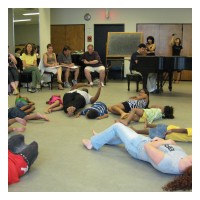
Children's movement class
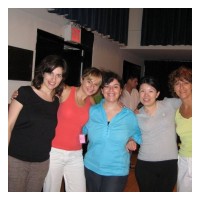
Yiyi with friends from Italy, Spain, Turkey, and Long Island!
What is Dalcroze?
Emile Jaques-Dalcroze (Swiss music educator, 1865-1950) believed that the core of all musical art is human emotion. He taught that it is not enough to train just the mind or the ear or the voice. Instead, the entire human body must be trained since the body contains all of the essentials for the development of sensibility and analysis of sound, music and feeling. Through participation in simple games, exercises, and improvisations, the students learn to combine music and movement in order to develop rhythmic unity between the eye, ear, mind, and body. Refining one's sense of musical rhythm provides a clear outward expression of inner knowledge and feeling. This ability enhances not only a person's performance, but also each and every person's life, as a creative and effective form of communication.
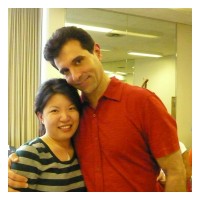
Yiyi with Dalcroze teacher Daniel Cataneo
The Dalcroze Method is a method of teaching musical concepts through movement. A variety of movement analogues are used for musical concepts, to develop an integrated and natural feel for musical expression. Turning the body into a well-tuned musical instrument, Dalcroze felt, was the best path to generating a solid, vibrant musical foundation. The Dalcroze Method consists of three equally important elements: Eurhythmics, solfege, and improvisation. Together, according to Dalcroze, they comprise the musicianship training of a complete musician. In an ideal approach, elements from each subject blend together, resulting in teaching rooted in creativity and movement.
Created at LetterPop.com
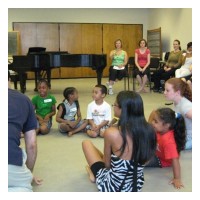
Yiyi's thoughts
- Solfege versus ABC: Yiyi has always believed the Solfege system (naming notes with Do-Re-Mi) to be far more superior than using letters. Solfege was used throughout the workshop, and participants with extensive solfege background performed much better in all areas.
- Singing the notes while playing: the human voice is the most direct and intimate of all instruments; singing develops inner hearing - the most powerful resource for a musician.
- Eurhythmics: learning and experiencing music through movement and other non-direct means.
- Improvisation: this area is often left out in traditional instrumental teaching methods.
Teaching applications
- start a Eurhythmics class for pre-school children
- use Solfege completely!
- encourage more singing from students
- monthly group make-up classes: students learn "attention", "quick reaction", "follow", "interrupted and continuous canon" and benefit from "social interaction"
- incorporate Dalcroze principles in teaching interpretation and solving technical difficulties
- encourage creative composition and improvisation
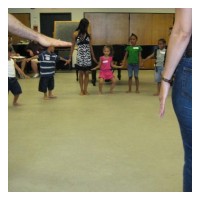
All children are musical.
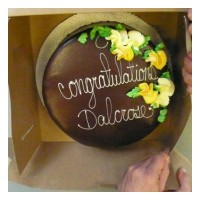
Cake-and-champaign party at the end of the workshop!
Music education is a long term commitment and requires much effort from the teacher, parents/guardians, and the students involved. The 3 week workshop not only provided training on the Dalcroze methods, but also confirmed Yiyi's own teaching philosophies. When teaching young beginners, my emphasis has always been to show them how to make music, however simple. I use solfege before introducing letters so that when notes are referred to, there is always an inherent pitch relationship. Actually 'experiencing' music through listening, singing and playing is far more important than 'labeling' music - the ability to name this and that note or this and that sign/symbol/instrument. Letters and names can and will come later.
The workshop also gave Yiyi many networking opportunities. It was indeed great to learn, meet new friends, and have fun!
Created at LetterPop.com